



Ziovan
- ENG
- မြန်မာ
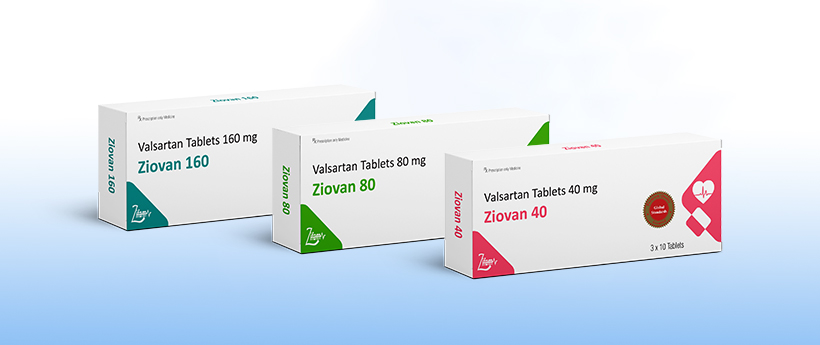
Valsartan Tablets
ZIOVAN 40
Composition:
Each film coated tablet contains:
Valsartan……………………………. 40 mg
ZIOVAN 80
Composition:
Valsartan……………………………. 80 mg
ZIOVAN 160
Composition:
Valsartan……………………………. 160 mg
1. DESCRIPTION
Valsartan is a nonpeptide, orally active, and specific angiotensin Il receptor blocker acting on the AT1 receptor subtype.
Valsartan is a white to practically white fine powder. It is soluble in ethanol and methanol and slightly soluble in water. ZIOVAN is available as film-coated tablets for oral administration, containing 40 mg, 80 mg and 160 mg of valsartan.
2. CLINICAL PHARMACOLOGY
2.1. Mechanism of Action
Angiotensin Il is formed from angiotensin I in a reaction catalyzed by angiotensin-converting enzyme (ACE, kinase II). Angiotensin Il is the principal pressor agent of the renin-angiotensin system, with effects that include vasoconstriction, stimulation of synthesis and release of aldosterone, cardiac stimulation, and renal reabsorption of sodium. Ziovan (valsartan) blocks the vasoconstrictor and aldosterone-secreting effects of angiotensin ll by selectively blocking the binding of angiotensin l to the AT receptor in many tissues, such as vascular smooth muscle and the adrenal gland. Its action is therefore independent of the pathways for angiotensin Il synthesis.
There is also an AT2 receptor found in many tissues, but AT2 is not known to be associated with cardiovascular homeostasis. Valsartan has much greater affinity (about 20,000-fold) for the AT1 receptor than for the AT2 receptor. The increased plasma levels of angiotensin Il following AT1 receptor blockade with valsartan may stimulate the unblocked AT2 receptor. The primary metabolite of valsartan is essentially inactive with an affinity for the AT 1 receptor about one 200th that of valsartan itself.
Blockade of the renin-angiotensin system with ACE inhibitors, which inhibit the biosynthesis of angiotensin Il from angiotensin I, is widely used in the treatment of hypertension. ACE inhibitors also inhibit the degradation of bradykinin, a reaction also catalyzed by ACE. Because valsartan does not inhibit ACE (kininase Il), it does not affect the response to bradykinin. Whether this difference has clinical relevance is not yet known. Valsartan does not bind to or block other hormone receptors or ion channels known to be important in cardiovascular regulation.
Blockade of the angiotensin Il receptor inhibits the negative regulatory feedback of angiotensin Il on renin secretion, but the resulting increased plasma renin activity and angiotensin Il circulating levels do not overcome the effect of valsartan on blood pressure.
3. INDICATIONS AND USAGE
3.1 Hypertension
Valsartan is indicated for the treatment of hypertension, to lower blood pressure. Lowering blood pressure reduces the risk of fatal and nonfatal cardiovascular events, primarily strokes and myocardial infarctions.
Ziovan may be used alone or in combination with other antihypertensive agents.
3.2 Heart Failure
Ziovan is indicated for the treatment of heart failure
(NYHA Class I|-IV)
3.3 Post-Myocardial Infarction
In clinically stable patients with left ventricular failure or left ventricular dysfunction following myocardial infarction, Ziovan is indicated to reduce cardiovascular mortality.
4. DOSAGE AND ADMINISTRATION
4.1 Adult Hypertension
The recommended starting dose of Ziovan (valsartan) is 80 mg or 160 mg once daily when used as monotherapy in patients who are not volume depleted. Patients requiring greater reductions may be started at a higher rate. The antihypertensive effect is substantially present within 2 weeks, and maximal reduction is generally attained after 4 weeks.
If additional antihypertensive effect is required over the starting dose range, a diuretic may be added Addition of a diuretic has a greater effect than dose increases beyond 80 mg.
No initial dosage adjustment is required for elderly patients, for patients with mild or moderate renal impairment, or for patients with mild or moderate liver insufficiency. Care should be exercised with dosing of Ziovan in patients with hepatic or severe renal impairment.
Ziovan may be administered with other antihypertensive agents
Ziovan may be administered with or without food.
4.2 Pediatric Hypertension 6-16 years of age
For children who can swallow tablets, the usual recommended starting dose is 1.3 mg/kg once dally (up to 40 mg total). The dosage should be adjusted according to blood pressure response. Doses higher than 2.7 mg/kg (up to 160 mg) once daily have not been studied in pediatric patients 6 to 16 years old.
Ziovan is not recommended for treatment of children below the age of 6 years or children of any age with a glomerular filtration rate <30 mL/min/1.73 m’, as no data are available.
4.3 Heart Failure
The recommended startina dose of Ziovan is 40 mg twice daily. Up-titration to 80 mg and 160 mg twice daily should be done to the highest dose, as tolerated by the patient. Consideration should be given to reducing the dose of concomitant diuretics. The maximum daily dose administered in clinical trials is 320 mg in individual doses.
4.4 Post-Myocardial Infarction
Valsartan may be initiated as early as 12 hours after a myocardial infarction. Valsartan may be given with other standard post-myocardial infarction treatment, including thrombolytics, aspirin, beta-blockers, and statins.
5. WARNINGS AND PRECAUTIONS
5.1 USE IN PREGNANCY: Fetal/ Neonatal
Morbidity and Mortality
When used in pregnancy, drugs that act directly on the renin-angiotensin system can cause injury and even death to the developing fetus. When pregnancy is detected, Ziovan should be discontinued as soon as possible.
Valsartan can cause fetal harm when administered to a pregnant woman. If this drug is used during pregnancy, or if the patient becomes pregnant while taking this drug, the patient should be appreciated of the potential hazard to the fetus.
Drugs that act on the renin angiotensin system can cause fetal and neonatal morbidity and mortality when used in pregnancy.
5.2 Hypotension
Excessive hypotension was rarely seen (0.1%) in patients with uncomplicated hypertension treated with Ziovan alone. In patients with an activated renin-angiotensin system, such as volume- and/or salt-depleted patients receiving high doses of diuretics, symptomatic hypotension may occur. This condition should be corrected prior to administration of Ziovan, or the treatment should start under close medical supervision.
Caution should be observed when initiating therapy in patients with heart failure or post-myocardial infarction patients. Patients with heart failure or post-myocardial infarction patients given Ziovan commonly have some reduction in blood pressure, but discontinuation of therapy because of continuing symptomatic hypotension usually is not necessary when dosing instructions are followed.
If excessive hypotension occurs, the patient should be placed in the supine position and, if necessary, given an intravenous infusion of normal saline. A transient hypotension is not a contraindication to further treatment, which usually can be continued without difficulty once the blood pressure has stabilized.
5.3 Impaired Renal Function
As most of the valsartan is eliminated in the bile, patients with mild-to-moderate hepatic impairment, including patients with biliary obstructive disorders, showed lower valsartan clearance (higher AUCs).
Care should be exercised in administering Ziovan to these patients.
Because of inhibiting the renin-angiotensin-aldosterone system, changes in renal function may be anticipated in susceptible individuals. In patients with severe heart failure whose renal function may depend on the activity of the renin- angiotensin-aldosterone system, treatment with angiotensin-converting enzyme inhibitors and angiotensin receptor antagonists has been associated with oliguria and/or progressive azotemia and (rarely) with acute renal failure and/or death. Similar outcomes have been reported with Valsartan.
Some patients with heart failure have developed increases in blood urea nitrogen, serum creatinine, and potassium. These effects are usually minor and transient, and they are more likely to occur in patients with pre-existing renal impairment. Dosage reduction and/or discontinuation of the diuretic and/or Valsartan may be required.
6. ADVERSE REACTIONS
6.1 The most common side effects of ZIOVAN used to treat patients with high blood pressure include: Headache, Dizziness, Flu Symptoms, Tiredness, Stomach/ Abdominal Pain.
6.2 The most common side effects of ZIOVAN used to treat patients with heart failure include:
Dizziness, Low Blood Pressure, Diarrhea, Joint and Back Pain, Tiredness, High Blood Potassium.
6.3 Common side effects of ZIOVAN used to treat people after a heart attack which caused them to stop taking the drug include: Low Blood Pressure, Cough, High Blood Creatinine (decreased kidney function), Rash.
7. DRUG INTERACTIONS
No clinically significant pharmacokinetic interactions were observed when Valsartan was co-administered with amlodipine, atenolol, cimetidine, digoxin, furosemide, glyburide, hydrochlorothiazide, or indomethacin. The valsartan-atenolol combination was more antihypertensive than either component, but it did not lower the heart rate than atenolol alone.
Coadministration of valsartan and wariarin did not change the pharmacokinetics of valsartan or the time-course of the anticoagulant properties of warfarin.
CYP 450 Interactions: The enzyme(s) responsible for valsartan metabolism have not been identified but do not seem to be CYP 450 isozymes. The inhibitory or induction potential of valsartan on CYP 450 is also unknown.
Transporters: The results from an in vitro study with human liver tissue indicate that valsartan is a substrate of the hepatic uptake transporter OATP1B1 and the hepatic efflux transporter MRP2. Co-administration of inhibitors of the uptake transporter (rifampin, cyclosporine) or efflux transporter (ritonavir) may increase the systemic exposure to valsartan.
As with other drugs that block angiotensin l or its effects, concomitant use of potassium sparing diuretics (e.g. spironolactone, triamterene, amiloride), potassium supplements, or salt substitutes containing potassium may lead to increases in serum potassium and in heart failure patients to increases in serum creatinine.
Non-Steroidal Anti-Inflammatory Agents including Selective Cyclooxygenase-2 Inhibitors (COX-2 Inhibitors): In patients who are elderly, volume-depleted (including those on diuretic therapy), or with compromised renal function, co-administration of NSAIDs, including selective COX-2 inhibitors, with angiotensin Il receptor antagonists, including valsartan, may result in deterioration of renal function, including possible acute renal failure. These effects are usually reversible. Monitor renal function periodically in patients receiving valsartan and NSAID therapy.
The antihypertensive effect of angiotensin Il receptor antagonists, including valsartan, may be attenuated by NSAIDs including selective COX-2 inhibitors.
8. USE IN SPECIFIC POPULATIONS
8.1 Pregnancy
Teratogenic Effects: Pregnancy Category D
Valsartan, like other drugs that act on the renin angiotensin system, can cause fetal and neonatal morbidity and death when used during the second or third trimester of pregnancy. Valsartan can cause fetal harm when administered to a pregnant woman. If this drug is used during pregnancy, or if the patient becomes pregnant while taking this drug, the patient should be apprised of the potential hazard to the When pregnancy occurs in a patient using Valsartan, the physician should discontinue Valsartan treatment as soon as possible. The physician should inform the patient about potential risks to the fetus based on the time of gestational exposure to Valsartan (first trimester only or later). If exposure occurs beyond the first trimester, an ultrasound examination should be done.
Infants with histories of utero exposure to Valsartan should be closely observed for hypotension, oliguria, and hyperkalemia. If oliguria occurs, these infants may require blood pressure and renal perfusion support. Exchange transfusion or dialysis may be required to reverse hypotension and/or support decreased renal function.
8.2 Nursing Mothers
It is not known whether Valsartan is excreted in human milk. Valsartan was excreted in the milk of lactating rats; however, animal breast milk drug levels may not accurately reflect human breast milk levels.
Because many drugs are excreted into human milk and because of the potential for adverse reactions in nursing infants from Valsartan, a decision should be made whether to discontinue nursing or discontinue the drug, considering the importance of the drug to the mother.
8.3 Pediatric Use
The antihypertensive effects of Valsartan have been evaluated in two randomized, double-blind clinical studies in pediatric patients from 1-5 and 6-16 years of age. The pharmacokinetics of Valsartan have been evaluated in pediatric patients 1 to 16 years of age. Valsartan was generally well tolerated in children 6-16 years and the adverse experience profile was similar to that described for adults. Valsartan is not recommended for pediatric patients under 6 years of age due to safety findings for which a relationship to treatment could not be excluded.
8.4 Geriatric Use
In the controlled clinical trials of valsartan, 1,214 (36.2%) of hypertensive patients treated with valsartan were ≥65 years and 265 (7.9%) were ≥75 years. No overall difference in the efficacy or safety of valsartan was observed in this patient population, but greater sensitivity of some older individuals cannot be ruled out.
Of the 2,511 patients with heart failure randomized to valsartan in the Valsartan Heart Failure Trial, 45% (1,141) were 65 years of age or older. In the Valsartan in Acute Myocardial Infarction Trial (VALIANT), 53% (2,596) of the 4,909 patients treated with valsartan and 51% (2,515) of the 4,885 patients treated with valsartan + captopril were 65 years of age or older.
There were no notable differences in efficacy or safety between older and younger patients in either trial.
9. OVER DOSAGE
Limited data are available related to over dosage in humans. The most likely manifestations of over dosage would be hypotension and tachycardia; bradycardia could occur from parasympathetic (vagal) stimulation. Depressed levels of consciousness, circulatory collapse and shock have been reported. If symptomatic hypotension should occur, supportive treatment should be instituted.
Valsartan is not removed from the plasma by hemodialysis
10. STORAGE
Store below 30°C. Protect from moisture.
KEEP MEDICINE OUT OF REACH OF CHILDREN.
11. PRESENTATION
Alu-Alu blister pack of 3×10’s in a carton along with pack insert.