



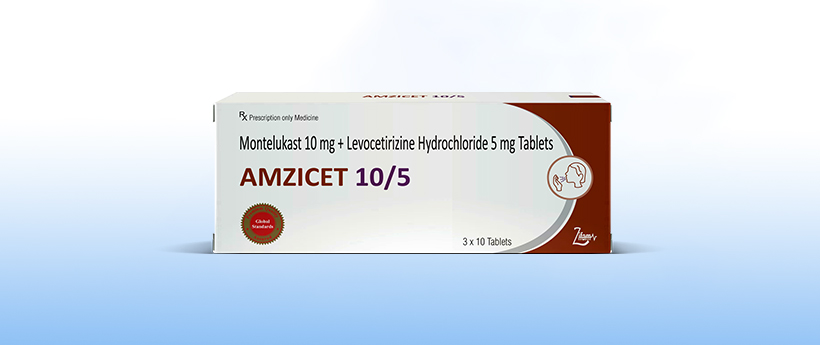
AMZICET 10/5
- ENG
- မြန်မာ
COMPOSITION
Each film-coated tablet contains:
Montelukast Sodium
Equivalent to Montelukast 10 mg
Levocetirizine Hydrochloride 5 mg
CLINICAL PARTICULARS
Therapeutic indications
It is indicated for relief and/or prevention of symptoms of allergic rhinitis (seasonal and perennial).
Posology and method of administration
Adults (>15 years): 1 tablet once daily
Method of Administration: The tablet must be taken orally, swallowed whole with liquid and may be taken with or without food.
Contraindications
Patients who are hypersensitive to any component of this product or to montelukast, levocetirizine, or cetirizine. Patients with completely impaired renal function (anuria), patients with severe renal impairment at less than 10ml/ min creatinine clearance.
Special warnings and precautions for use
Montelukast
Montelukast is not indicated for use in the reversal of bronchospasm in acute asthma attacks, including status asthmaticus. Patients should be advised to have appropriate rescue medication available. Therapy of montelukast can be continued during acute exacerbation of asthma. While the dose of inhaled corticosteroids may be reduced gradually under medical supervision, Montelukast should not be abruptly substituted for inhaled or oral corticosteroids. Montelukast should not be used as monotherapy for the treatment and management of exercise-induced bronchospasm. Patients who have exacerbations of asthma after exercise should continue to use their usual regimen of inhaled (beta)-agonists as prophylaxis and have available for rescue a short-acting inhaled (beta)-agonist. Patients with known aspirin sensitivity should continue avoidance of aspirin or non-steroidal anti-inflammatory agents while taking montelukast. Although montelukast is effective in improving airway function in asthmatics with documented aspirin sensitivity, it has not been shown to truncate bronchoconstrictor response to aspirin and other non-steroidal anti-inflammatory drugs in aspirin-sensitive asthmatic patients.
Eosinophilic Conditions:
In rare cases, patients on therapy with montelukast may present with systemic eosinophilia, sometimes presenting with clinical features of vasculitis consistent with Churg-Strauss syndrome, a condition, which is often treated with systemic corticosteroid therapy. These events usually, but not always, have been associated with the reduction of oral corticosteroid therapy.
Levocetirizine
Comparative clinical trials have revealed no evidence that levocetirizine at the recommended dose impairs mental alertness, reactivity or the ability to drive. In clinical trials the occurrence of somnolence, fatigue, and asthenia has been reported in some patients under therapy with levocetirizine. Patients should be cautioned against engaging in hazardous occupations requiring complete mental alertness, and motor coordination such as operating machinery or driving a motor vehicle after ingestion of levocetirizine. Concurrent use of levocetirizine with alcohol or other central nervous system depressants should be avoided because additional reductions in alertness and additional impairment of central nervous system may occur.
Patients with rare hereditary problems of galactose intolerance, the Lapp lactase deficiency or glucose galactose malabsorption should not take this medicine.
Interaction with other medicinal products and other forms of interaction
Montelukast
Montelukast may be administered with other therapies routinely used in prophylaxis and chronic treatment of asthma. In drug-interaction studies, the recommended clinical dose of montelukast did not have clinically important effects on the pharmacokinetics of the following drugs: theophylline, prednisone, prednisolone, oral contraceptives (norethindrone 1 mg/ethinyl estradiol 35 mcg), terfenadine, digoxin, and warfarin.
Although additional specific interaction studies were not performed, montelukast was used concomitantly with a wide range of commonly prescribed drugs in clinical studies without evidence of clinical adverse interactions. These medications included thyroid hormones, sedative hypnotics, non-steroidal anti-inflammatory agents, benzodiazepines, and decongestants.
Phenobarbital, which induces hepatic metabolism, decreased the AUC of montelukast approximately 40% following a single 10-mg dose of montelukast. No dosage adjustment for montelukast is recommended.
Levocetirizine
In vitro data indicates that levocetirizine is unlikely to produce pharmacokinetic interactions through inhibition or induction of liver drug-metabolizing enzymes. No in vivo drug-drug interaction studies have been performed with levocetirizine. Drug interaction studies have been performed with racemic cetirizine.
Pharmacokinetic interaction studies performed with racemic cetirizine demonstrated that cetirizine did not interact with antipyrine, pseudoephedrine, erythromycin, glipizide and diazepam, azithromycin, ketoconazole and cimetidine. There was a small decrease (~16%) in the clearance of cetirizine caused by a 400 mg dose of theophylline. It is possible that higher theophylline doses could have a greater effect.
Ritonavir increased the plasma AUC of cetirizine by about 42% accompanied by an increase in half-life (53%) and a decrease in clearance (29%) of cetirizine. The disposition of ritonavir was not altered by concomitant cetirizine administration.
Renal Impairment
As Levocetirizine is mainly excreted through urine, dosage adjustment may be required in patients with impaired renal function. Hence this combination should be used with caution in such patients.
Hepatic Impairment
As montelukast is mainly excreted through bile, caution is required while prescribing this combination in patients with impaired hepatic function.
Pregnancy and Lactation
Pregnancy
There are no adequate and well controlled studies of either montelukast or levocetirizine in pregnant women. Hence this combination should not be used during pregnancy.
Lactation
Since levocetirizine is excreted in breast milk, the combination is not recommended during lactation.
Effects on ability to drive and use machines
Montelukast
Montelukast is not expected to affect a patient’s ability to drive a car or operate machinery. However, in very rare cases, individuals have reported drowsiness or dizziness.
Levocetirizine
Objective measurements of driving ability, sleep latency and assembly line performance have not demonstrated any clinically relevant effects at the recommended dose of 5 mg.
Patients intending to drive, engaging in potentially hazardous activities or operating machinery should not exceed the recommended dose and should take their response to the medicinal product into account. In these sensitive patients, concurrent use with alcohol or other CNS depressants may cause additional reductions in alertness and impairment of performance.
Undesirable effects
Montelukast & Levocetirizine are generally well tolerated. Common side effects, which might be seen with the combination, are dyspepsia, abdominal pain, rash, dizziness, headache, fatigue, and somnolence. Sometimes, hypersensitivity, irritability, restlessness, insomnia, vomiting and diarrhea may occur. In rare cases, patients may present with systemic eosinophilia, sometimes presenting with clinical features of consistent with ChurgStrauss Syndrome.
Overdose
There is no data reported on the overdosage of this combination. However, overdosage has been reported with individual molecules.
Montelukast
There have been reports of acute overdosage in post-marketing experience and clinical studies with montelukast. These include reports on adults and children with a dose as high as 1000 mg. The clinical and laboratory findings observed were consistent with the safety profile in adults and pediatric patients. There were no adverse experiences in the majority of overdosage reports. The most frequently occurring adverse experiences were consistent with the safety profile of montelukast and included abdominal pain, somnolence, thirst, headache, vomiting and psychomotor hyperactivity.
It is not known whether montelukast is removed by peritoneal dialysis or hemodialysis.
Levocetirizine
Symptoms of overdose may include drowsiness in adults and initially agitation and restlessness followed by drowsiness, in children. There is no known specific antidote to levocetirizine. Should overdose occur, symptomatic or supportive treatment is recommended. Levocetirizine is not effectively removed by dialysis and dialysis will be ineffective unless a dialyzable agent has been concomitantly ingested.
PHARMACOLOGICAL PROPERTIES
Pharmacodynamics properties
Montelukast
Montelukast Sodium is a selective and orally active leukotriene receptor antagonist that inhibits the cysteinyl leukotriene (CysLT1) receptor. Montelukast causes inhibition of airway cysteinyl leukotriene receptors as demonstrated by the ability to inhibit bronchoconstriction due to inhaled LTD 4 in asthmatics.
Doses as low as 5 mg cause substantial blockage of LTD 4 -induced bronchoconstriction.
Levocetirizine
Levocetirizine, the R-enantomer of cetirizine, is a potent and selective antagonist of peripheral H1-receptors. Binding studies revealed that levocetirizine has high affinity for human H1 -receptors (Ki = 3.2 nmol/l). Levocetirizine has an affinity 2-fold higher than that of cetirizine (Ki = 6.3 nmol/l). Levocetirizine dissociates from H1 -receptors with a half-life of 115 + 38 min.
Pharmacodynamic studies in healthy volunteers demonstrate that at half the dose levocetirizine has comparable activity to cetirizine, both in the skin and in the nose. Pharmacokinetic/ pharmacodynamic relationship 5 mg levocetirizine provide a similar pattern of inhibition of histamine-induced wheel and flare than 10 mg cetirizine. As for cetirizine, the action on histamine-induced skin reactions was out of phase with the plasma concentrations. ECGs did not show relevant effects of levocetirizine on QT interval.
Pharmacokinetic properties
Montelukast
Absorption
After administration of the 10 mg film-coated tablet to fasted adults, the mean peak montelukast plasma concentration (Cmax) is achieved in 3 to 4 hours (Tmax). The mean oral bioavailability is 64%. The oral bioavailability and Cmax are not influenced by a standard meal in the morning.
Distribution
Montelukast is more than 99% bound to plasma proteins. The steady-state volume of distribution of montelukast averages 8 to 11 liters.
Metabolism
Montelukast is extensively metabolized. In studies with therapeutic doses, plasma concentrations of metabolites of montelukast are undetectable at steady state in adults and pediatric patients.
Elimination
The plasma clearance of montelukast averages 45mL/min in healthy adults.
Following an oral dose of radiolabeled montelukast, 86% of the radioactivity was recovered in 5-day fecal collections and <0.2% was recovered in urine. Coupled with estimates of montelukast oral bioavailability, this indicates that montelukast and its metabolites are excreted almost exclusively via the bile.
In several studies, the mean plasma half-life of montelukast ranged from 2.7 to 5.5 hours in healthy young adults. The pharmacokinetics of montelukast is nearly linear for oral doses up to 50 mg. During once-daily dosing with 10 mg montelukast, there is little accumulation of the parent drug in plasma (14%).
Levocetirizine
The pharmacokinetics of levocetirizine is linear with dose and time independent with low inter-subject variability. The pharmacokinetic profile is the same when given as the single enantiomer or when given as cetirizine. No chiral inversion occurs during the process of absorption and elimination.
Absorption
Levocetirizine is rapidly and extensively absorbed following oral administration.
Peak plasma concentrations are achieved 0.9 g h after dosing. Steady state is chieved after two days. Peak concentrations are typically 270ng/ml and 308ng/ml following a single and a repeated 5 mg o.d. dose, respectively. The extent of absorption is dose-independent and is not altered by food, but the peak concentration is reduced and delayed.
Distribution
No tissue distribution data are available in humans, neither concerning the passage of levocetirizine through the blood-brain-barrier. Levocetirizine is 90% bound to plasma proteins. The distribution of levocetirizine is restrictive, as the volume of distribution is 0.4 l/kg.
Metabolism
The extent of metabolism of levocetirizine in humans is less than 14% of the dose and therefore differences resulting from genetic polymorphism or concomitant intake of enzyme inhibitors are expected to be negligible. Metabolic pathways include aromatic oxidation, N- and O-dealkylation and taurine conjugation.
Dealkylation pathways are primarily mediated by CYP 3A4 while aromatic oxidation involved multiple and/or unidentified CYP isoforms. Levocetirizine had no effect on the activities of CYP isoenzymes 1A2, 2C9, 2C19, 2D6, 2E1 and 3A4 at concentrations well above peak concentrations achieved following a 5 mg oral dose.
Due to its low metabolism and absence of metabolic inhibition potential, the interaction of levocetirizine with other substances or vice-versa, is unlikely.
Elimination
The plasma half-life in adults is 7.9 + 1.9 hours. The mean apparent total body clearance is 0.63 ml/min kg. The major route of excretion of levocetirizine and metabolites is via urine, accounting for a mean of 85.4% of the dose. Excretion via faces accounts for only 12.9% of the dose. Levocetirizine is excreted both by glomerular filtration and active tubular secretion.
Preclinical safety data
Levocetirizine
Non-clinical data reveal no special hazard for humans based on conventional studies of safety pharmacology, repeated dose toxicity, genotoxicity, carcinogenic potential, toxicity to reproduction.
Montelukast
Montelukast was determined not to be phototoxic in mice for UVA, UVB or visible light spectra at doses up to 500 mg/kg/day (approximately >200-fold based on systemic exposure. Montelukast was neither mutagenic in vitro and in vivo tests nor tumorigenic in rodent species.
STORAGE
Store below 30°C. Protect from light and moisture.
PRESENTATION
Alu-Alu Blister pack of 3 x 10’s in a carton along with pack insert.
KEEP MEDICINE OUT OF REACH OF CHILDREN.