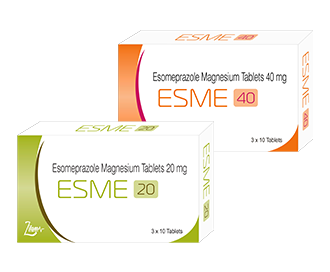



Esme 40 IV
- ENG
- မြန်မာ

Esomeprazole Sodium for Injection
Composition:
Each vial contains:
Esomeprazole Sodium Eq. to Esomeprazole………….40mg
(As-Lyophilized powder)
Each Ampoule contains:
Sodium chloride 0.9% w/v USP 5ml
FOR IV USE ONLY
LYOPHILIZED INJECTION
INDICATION. Esomeprazole Sodium Injection contains esomeprazole as active Ingredient. This belongs to a group of medicines called ‘proton pump inhibitors’. They work by reducing the amount of acid that your stomach produces. Esomeprazole Sodium Injection is used for the short-term treatment of certain conditions, when you are unable to have treatment by mouth. It is used to treat: “Gastroesophageal reflux disease’ (GERD) in adults, adolescents and children. This is where acid from the stomach escapes into the gullet (the tube which connects your throat to your stomach) causing pain, inflammation and heartburn.
- Stomach ulcers in adults caused by medicines called NSAIDs (Non-Steroidal Anti-Inflammatory Drugs). Esomeprazole can also be used to stop stomach ulcers from forming if you are taking NSAIDs.
- Prevention of rebleeding in adults following therapeutic endoscopy for acute bleeding gastric or duodenal ulcers.
Do not use Esomeprazole Sodium Injection:
- if you are allergic to esomeprazole or any of the other ingredients of this medicine
- if you are allergic to other proton pump inhibitor medicines (e.g. pantoprazole, lansoprazole, rabeprazole, omeprazole)
- if you are taking a medicine containing nelfinavir (used to treat HIV)
WARNING AND PRECAUTION: – Talk to your doctor or pharmacist if you have: –
- severe liver problems
- severe kidney problems
- ever had a skin reaction after treatment with a medicine similar to esomeprazole that reduces stomach acid
- specific blood test (Chromogranin A) If you get rash on your skin, especially in areas exposed to the sun tell your doctor as soon as you can, as you may need to stop your treatment with esomeprazole
- pass black stools (blood-stained feces)
DRUG INTERACTIONS: Esomeprazole may interact with:
- Atazanavir (used to treat HIV).
- Clopidogrel (used to prevent blood clots).
- Ketoconazole, itraconazole or voriconazole (used to treat infections caused by a fungus) crotnit (used to treat cancer
- Citalopram, impramine or clomipramine (used to treat depression)
- Diazepam (used to treat anxiety, relax muscles or in epilepsy).
- Phenytoin (used in epilepsy).
- Medicines that are used to thin your blood, such as warfarin.
- Cilostazol (used to treat intermittent claudication)
- Cisapride (used for indigestion and heartburn).
- Digoxin (used for heart problems).
- Methotrexate (a chemotherapy medicine used in high doses to treat cancer)
- Tacrolimus (organ transplantation).
- Rifampicin (used for treatment of tuberculosis.
- John’s wort (Hypericum perforatum) (used to treat depression).
Pregnancy, Breast-feeding and Fertility: If you are pregnant or breast feeding, think you may be pregnant or are planning to have a baby, ask your doctor or pharmacist for device before taking this medicine. It is not known if esomeprazole passes into breast milk. Therefore, you should not be given esomeprazole if you are breast feeding, Driving and using machines Esomeprazole is not likely to affect you being able to drive or use any tools or machines.
DOSAGE: Esomeprazole can be given to children and adolescents aged 1-18 years and adults, including the elderly.
- The usual dose is 20 mg or 40 mg once a day.
- If you have severe liver problems, the maximum dose for GERD is 20 mg a day.
- The usual dose for prevention of rebleeding of gastric or duodenal ulcer is 80 mg administered as intravenous infusion over 30 minutes followed by a continuous infusion of 8 mg/hr. given over 3 days. continuous infusion of 4 mg/hr given over 3 days may be sufficient. Use in children and adolescents aged 1-18 years
- For children 1-11 years, the usual dose is 10 or 20 mg given once a day.
- For children 12-18 years, the usual dose is 20 or 40 mg given once a day.
POSSIBLE SIDE EFFECTS:
- Sudden wheezing, swelling of your lips, tongue and throat or body, rash, fainting or difficulties in swallowing (severe allergic reaction)
- Reddening of the skin with blisters or peeling. There may also be severe blisters and bleeding in the lips, eyes, mouth, nose and genitals. This could be ‘Stevens-Johnson syndrome or “toxic epidermal necrolysis”.
- Yellow skin, dark urine and tiredness which can be symptoms of liver problems. These effects are rare, may affect up to 1 in 1,000 people.
Other side effects include:
Common (may affect up to 1 in 10 people)
- Headache
- Effects on your stomach or gut: diarrhea, stomach pain, constipation, wind (flatulence).
- Feeling sick (nausea) or being sick (vomiting).
- Injection site reaction.
- Uncommon (may affect up to 1 in 100 people)
- Swelling of the feet and ankles.
- Disturbed sleep(insomnia).
- Dizziness, tingling feelings such as “pins and needles”, feeling sleepy.
- Spinning feeling (vertigo).
- Eyesight problems such as blurred vision.
- Dry mouth
- Changes in blood tests that check how the liver is working
- Skin rash, lumpy rash (hives) and itchy skin